GPS Time Machine: The AI Prompt Hack That Photographs History
What if your camera could time travel? Type GPS coordinates, a date, and a time — the AI reconstructs the scene. Try it with the Great Pyramid, Pompeii, and more.
March 17, 2026
•By VibeArt Team•
8 min read
•— views
What if your camera could time travel?
No flux capacitor. No phone booth. No spinning vortex. Just seven words, a set of coordinates, and a date — and suddenly you are standing in front of the Great Pyramid while it is being built.
That is exactly what happens when you use the GPS Time Machine prompt technique with AI image generation. It is one of the simplest, most mind-blowing creative hacks we have seen — and once you try it, you will never look at a set of GPS coordinates the same way again.
Here is the idea: you give an AI model a prompt formatted like a camera timestamp — latitude, longitude, historical date, time of day — and the model synthesizes everything it knows about that place and that moment to generate a "photograph" you could never have taken.
The results are stunning. And the prompt is absurdly simple.
The Prompt Formula: Coordinates + Date + Time = Time Travel
The template looks like this:
take a photo at [LATITUDE], [LONGITUDE], [DATE], [TIME] hours
That is it. No style modifiers. No "cinematic lighting, 8K, hyper-realistic" incantations. Just the raw facts of where and when, and the AI fills in the rest.
Why does this work so well? Because modern AI models like Gemini have internalized an enormous amount of world knowledge — geography, architecture, historical events, weather patterns, clothing, technology. When you anchor a prompt with precise coordinates and a specific date, you activate all of that latent knowledge at once. The model does not just illustrate a concept; it reconstructs a scene.
"GPS coordinates are the secret cheat code for AI image generation. You are not describing a picture — you are dropping a pin in spacetime."
We tested this technique on VibeArt using Gemini 3.1 Flash, and the four images we got back genuinely made us stop and stare. Let us walk through each one.
Four Moments That Changed the World — "Photographed" by AI
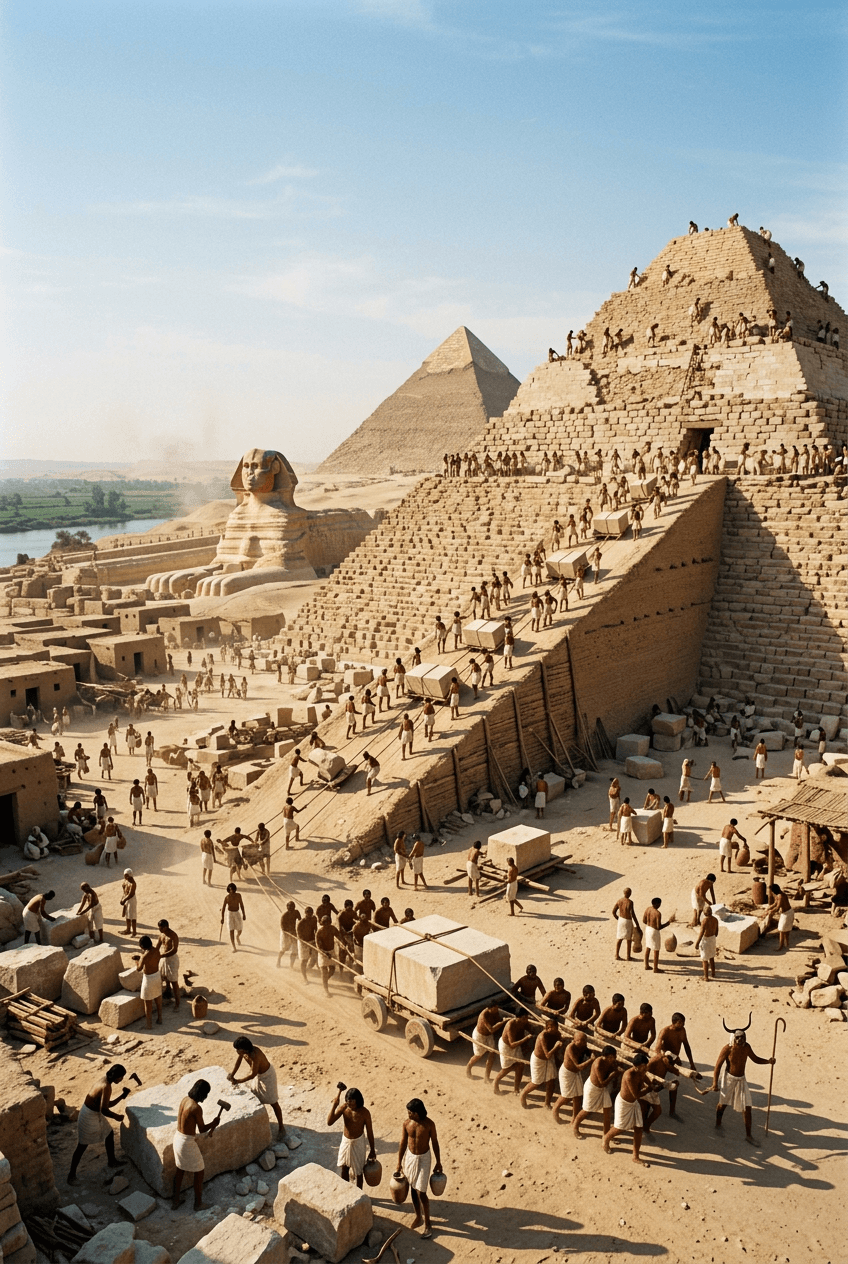
1. The Great Pyramid of Giza Under Construction (2560 BCE)
take a photo at 29.9792° N, 31.1342° E, 2560 BCE, 08:00 hours
Location decoded: Giza Plateau, Egypt — the exact coordinates of the Great Pyramid of Khufu.
The morning sun hits the Giza plateau at 8 AM and you see it: the Great Pyramid, not yet finished, surrounded by the organized chaos of one of humanity's most ambitious construction projects. Workers, ramps, limestone blocks catching the golden light.
What is remarkable here is how the AI interpreted "2560 BCE" — it did not generate a completed tourist-attraction pyramid. It understood the date placed us during construction, roughly when Pharaoh Khufu's monument was being raised. The morning timestamp gives us that warm, low-angle Egyptian light that makes the desert glow.
This single image captures something no photograph ever could: the Pyramid as a work in progress. A building site, not a wonder. Human effort, not timeless mystery.
2. The Crucifixion — Jerusalem, 33 CE
take a photo at 31.7785° N, 35.2296° E, April 3, 33 CE, 15:00 hours
Location decoded: Golgotha (Calvary), Jerusalem — the traditional site of the crucifixion of Jesus.
This is where the technique becomes genuinely eerie. The coordinates point to the Church of the Holy Sepulchre in modern Jerusalem — the site traditionally identified as Golgotha. April 3, 33 CE is one of the dates scholars have calculated for the crucifixion based on astronomical and calendar analysis. And 3 PM (the "ninth hour" in biblical reckoning) is the time the Gospels record.
The AI did not need to be told "generate a crucifixion scene." The coordinates, the date, and the time were enough. The model connected the dots across geography, history, and cultural knowledge to reconstruct the moment.
Whether you approach this as history, faith, or pure AI capability, the result is arresting.
3. The Eruption of Vesuvius — Pompeii, 79 CE
take a photo at 40.7507° N, 14.4890° E, August 24, 79 CE, 13:00 hours
Location decoded: Pompeii, Italy — at the foot of Mount Vesuvius.
1 PM on August 24, 79 CE. You are standing in Pompeii. The sky is darkening. Vesuvius has begun to erupt.
The AI captures the terrifying scale of the eruption column — the towering pillar of ash and pumice that Pliny the Younger famously described as looking like an umbrella pine tree. The Roman architecture of Pompeii sits in the foreground, about to be buried under meters of volcanic debris and preserved for nearly two thousand years.
The 1 PM timestamp is historically significant: the eruption is believed to have started around midday, meaning the citizens of Pompeii had only hours before the pyroclastic surges made escape impossible. This image freezes the narrow window between normalcy and catastrophe.
4. Storming of the Bastille — Paris, 1789
take a photo at 48.8533° N, 2.3692° E, July 14, 1789, 17:00 hours
Location decoded: Place de la Bastille, Paris — the site of the Bastille fortress-prison.
The birth of modern revolution. By 5 PM on July 14, 1789, the crowd had already breached the outer courtyard and the fortress was under full assault. The governor would surrender within the hour.
The AI renders revolutionary Paris with remarkable atmosphere — the smoke, the mass of people, the imposing medieval fortress that had become the most hated symbol of royal tyranny. The late-afternoon light gives the scene a golden, almost cinematic quality that contrasts powerfully with the violence of the moment.
This is perhaps the most "photojournalistic" of the four images. It feels like a war correspondent's shot — chaotic, immediate, caught in the middle of history happening.
Try It Yourself: 8 More GPS Time Machine Prompts
Ready to drop your own pins in history? Here are eight prompts to try. Copy them directly into VibeArt or any AI image generator that supports Gemini:
The Moon Landing (1969)
take a photo at 0.6744° N, 23.4731° E, July 20, 1969, 20:17 hours
Tranquility Base, the Moon. The exact moment of touchdown.
Fall of the Berlin Wall (1989)
take a photo at 52.5163° N, 13.3777° E, November 9, 1989, 23:00 hours
Brandenburg Gate, Berlin. The night the wall came down.
Signing of the Declaration of Independence (1776)
take a photo at 39.9489° N, 75.1500° W, July 4, 1776, 14:00 hours
Independence Hall, Philadelphia. The afternoon that created a nation.
First Powered Flight at Kitty Hawk (1903)
take a photo at 36.0148° N, 75.6674° W, December 17, 1903, 10:35 hours
Kill Devil Hills, North Carolina. Twelve seconds that changed everything.
The Great Fire of London (1666)
take a photo at 51.5098° N, 0.0860° W, September 2, 1666, 02:00 hours
Pudding Lane, London. The bakery where the fire started, 2 AM.
Woodstock Music Festival (1969)
take a photo at 41.7122° N, 74.8814° W, August 15, 1969, 17:07 hours
Bethel, New York. Richie Havens opens the festival.
The Titanic Strikes the Iceberg (1912)
take a photo at 41.7260° N, 49.9469° W, April 14, 1912, 23:40 hours
North Atlantic Ocean. Eleven forty PM. Iceberg, dead ahead.
The March on Washington (1963)
take a photo at 38.8893° N, 77.0502° W, August 28, 1963, 15:00 hours
Lincoln Memorial, Washington D.C. "I have a dream..."
Copy the template. Change the coordinates. Change the date. You now have a time machine.
Why This Works: The Science Behind the Magic
The GPS Time Machine technique works because of three things converging inside modern AI models:
1. Spatial knowledge. Large language models and multimodal models have been trained on billions of web pages, many of which associate GPS coordinates with specific locations. When you input 29.9792° N, 31.1342° E, the model knows you mean Giza with high confidence — and it knows what Giza looks like, what the terrain is, what the climate is.
2. Historical knowledge. These models have ingested enormous amounts of historical text, artwork, and photography. A date like "2560 BCE" activates knowledge about ancient Egypt, pyramid construction methods, clothing, tools, and social structures. The model is not guessing — it is synthesizing from a vast knowledge base.
3. Temporal reasoning. The time-of-day component is surprisingly powerful. "08:00 hours" in Egypt means low, warm light from the east. "15:00 hours" in Jerusalem means harsh afternoon sun. "23:40 hours" in the North Atlantic means darkness. The model uses this to set lighting, mood, and atmosphere in ways that feel cinematically authentic.
The genius of the prompt format is its restraint. By giving the model only coordinates, date, and time — no adjectives, no style instructions, no emotional cues — you force it to do all the creative interpretation itself. The result feels more authentic precisely because it was not over-directed.
"The best AI prompts do not describe the output. They describe the conditions that would produce it."
Your Turn: Build Your Own GPS Time Machine Collection
The GPS Time Machine is more than a clever prompt trick. It is a new way to engage with history — visceral, visual, and immediate. Every set of coordinates tells a story. Every timestamp is a window.
And the prompt library is literally infinite. Any place. Any date. Any time. The entire span of human history (and prehistory, and the future) is available.
Here is your starter template:
take a photo at [LATITUDE], [LONGITUDE], [DATE], [TIME] hours
Some tips for the best results:
Use precise coordinates (Google Maps, right-click, "Copy coordinates")
Be specific with dates — day and month matter for lighting and season
Time of day dramatically affects mood: dawn for hope, noon for harshness, dusk for drama, midnight for mystery
Try moments just before or after the famous event for unexpected perspectives
Experiment with lesser-known historical moments — the AI's results can surprise you
Ready to start time traveling?
Try the GPS Time Machine on VibeArt — generate your first "time travel photo" in seconds. No sign-up wall. Pick your coordinates, choose your moment in history, and see what the AI brings back.
You can also explore the original GPS Time Machine canvas that inspired this article: View the canvas on VibeArt
What moment in history would you photograph first? Share your GPS Time Machine results with us — we would love to see where (and when) you go.